Building a Production Website Chatbot with RAG: An Advanced Engineering Guide
Building a Production Website Chatbot with RAG: An Advanced Engineering Guide
- Details
- Category: Language & Agentic AI
A website chatbot is easy to prototype and difficult to make trustworthy. A text box, a model API, and a streaming response can produce a convincing demonstration in a few hours. A production chatbot has to solve a much larger engineering problem: it must decide when to answer, find the right evidence, respect access boundaries, preserve conversation state, survive partial failures, expose citations, control tool actions, manage latency and cost, and provide enough telemetry to explain why a bad answer happened.
For many business chatbots, Retrieval-Augmented Generation (RAG) becomes the central knowledge mechanism because the information required for an answer lives outside the model. Product documentation changes. Policies have effective dates. Internal procedures are private. Account state belongs to operational systems. A model trained months earlier cannot be treated as the authoritative store for these facts.
RAG addresses part of this problem by retrieving external evidence at inference time and supplying selected passages to the language model. The original RAG work by Lewis et al. combines a parametric generator with external retrieved memory, while dense-retrieval work such as Dense Passage Retrieval demonstrates how learned representations can retrieve passages beyond exact lexical matching.
RAG does not guarantee factual answers. A production system can retrieve the wrong passage, omit a critical exception, use an obsolete document, cross a tenant boundary, include malicious instructions embedded in retrieved content, overload the context window, or generate claims that the evidence does not support. Reliability therefore comes from the architecture around retrieval and generation, not from the presence of a vector database.
This guide treats the chatbot as a complete software and ML system. It covers scope definition, frontend interaction, a working Gradio interface, API boundaries, conversation state, document ingestion, chunking, metadata, access control, sparse and dense retrieval, hybrid fusion, reranking, context packing, generation, citations, tools, security, streaming, caching, observability, evaluation, deployment, rollback, and continuous improvement.
Prerequisites and scope
The material assumes familiarity with HTTP APIs, Python, supervised evaluation concepts, vector similarity, and the basic behavior of large language models. The examples use support-style question answering because it exposes most of the important architecture choices without requiring domain-specific regulation.
The guide does not assume one model provider, vector database, orchestration framework, or frontend framework. Those components change quickly. The architecture is intentionally described through contracts so that implementations can be replaced without rewriting the complete system.
The most important boundary is between evidence and authority. Documents can provide evidence. Transactional systems can provide live state. The language model can synthesize and explain. The model should not silently become the authority for permissions, money movement, account state, or other consequential side effects.
Start with the chatbot's authority, not the model
The first design document should define what the chatbot is allowed to do.
A public documentation assistant may answer questions from published sources and never access user-specific data. An authenticated support assistant may retrieve private workspace documentation and read account state. An operations assistant may call internal tools and request human approval before changing production state.
These systems can share the same chat UI but require different threat models, logging policies, retrieval filters, and escalation paths.
| User need | Preferred mechanism | Source of truth |
|---|---|---|
| Stable public FAQ | Curated answer or simple retrieval | Published documentation |
| Current product or policy knowledge | RAG | Versioned knowledge corpus |
| Order, ticket, balance, quota, or entitlement | Authenticated read tool | Operational database or service API |
| Refund, cancellation, approval, or other side effect | Authorized tool with explicit policy | Transactional service |
| Unsupported or ambiguous question | Clarification, abstention, or escalation | No sufficient evidence |
This classification prevents a common architectural error: putting every kind of information into the vector store. A vector index is useful for unstructured knowledge retrieval. It is usually the wrong source of truth for current account state, inventory, permissions, balances, or workflow status.
Define the response contract before implementing RAG
The frontend should not receive an unstructured string as the only response object. A production response should carry enough metadata for the application to render, audit, and recover the interaction.
A useful response contract can contain a durable run identifier, answer text, source references, model and knowledge versions, status, refusal or escalation reason, and timing metadata. The exact schema depends on the product, but the principle is stable: the application should not need to parse prose to determine whether the answer is final, partial, unsupported, or awaiting approval.
response = {
    "run_id": "run-2026-0810-0042",
    "status": "completed",
    "answer": "The documented default retention period is 30 days.",
    "sources": [
        {
            "document_id": "retention-policy",
            "version": "2026-07-15",
            "section": "Default retention",
        }
    ],
    "grounding": "supported",
    "escalation": None,
}
This object is an architectural example. The important property is that answer text and operational state are separate fields.
A reference production architecture
The browser should own user interaction, not business truth. The API layer should own authentication, rate limiting, request validation, and transport. The orchestrator should decide whether to use conversation memory, retrieval, tools, clarification, or refusal. The retrieval subsystem should own document eligibility and ranking. The model runtime should generate from bounded inputs. A validation layer should check output contracts and source support before the response is released.

The separation creates replaceable boundaries. A new embedding model can require an index migration without changing the conversation schema. A new LLM can be evaluated against the same retrieved evidence. A different frontend can reuse the same API and run state. A retrieval incident can be diagnosed without assuming that the generator is responsible.
Use durable run state instead of a request-only conversation
Every meaningful request should have an identifier that survives the network connection. This matters for streaming, retries, reconnects, user feedback, observability, and asynchronous work.
A run record can store the user message, normalized request, routing decision, retrieval query, selected source IDs, prompt version, model version, tool results, timestamps, final answer, and evaluation signals.
Do not store every internal implementation detail forever. Logging and retention should respect data minimization and privacy requirements. The design goal is reconstructability: the team should be able to explain the important decisions that produced a response without retaining unnecessary sensitive content.
Ingestion is part of model quality
The online system can retrieve only what the offline knowledge pipeline has represented correctly.
Ingestion begins with source discovery and document identity. A page should have a stable identifier independent of its current URL when possible. The system should know when a document was created, updated, superseded, deleted, or restricted.
Parsing comes next. HTML navigation, PDF headers, two-column layouts, OCR artifacts, repeated disclaimers, hidden elements, and tables can all distort the text supplied to the retriever. If the parser merges unrelated cells or repeats navigation text in every chunk, the embedding model is not the first problem.
A robust pipeline stores both the canonical source and an inspectable parsed representation. Engineers should be able to compare the chunk with the document a user or domain expert sees.
Version the knowledge pipeline as aggressively as the model
A retrieval result depends on more than the embedding model. It depends on parser version, cleaning rules, chunking logic, metadata mapping, embedding configuration, index build, and deletion state.
Every indexed chunk should be attributable to a knowledge build. If a new parser accidentally removes table headers, rollback should mean selecting the previous complete build, not trying to reverse individual vectors in place.
| Field | Example | Why it matters |
|---|---|---|
| Document ID | policy-refunds |
Stable identity across updates |
| Document version | 2026-07-15 |
Distinguishes current and superseded content |
| Parser version | html-cleaner-v4 |
Explains text representation changes |
| Chunking version | section-chunker-v3 |
Explains changed retrieval boundaries |
| Embedding version | embedding-v5 |
Identifies the representation space |
| Index build | kb-2026-08-10-02 |
Allows atomic promotion and rollback |
Chunk according to meaning before counting tokens
Chunking is one of the most consequential RAG choices because it defines the unit that retrieval can return.
A universal rule such as "500 tokens with 50-token overlap" is operationally convenient but not semantically justified. A troubleshooting procedure may need a sequence of steps. A legal clause may depend on the preceding definition. An API endpoint description may need its parameter table. A pricing page may need a plan heading and a feature row together.
Start with document structure. Preserve headings, paragraph groups, list blocks, table rows with headers, code examples, and parent sections. Apply size limits only after identifying meaningful units.
If a section is too large, split it hierarchically and preserve parent metadata. This supports retrieval of a precise child passage while allowing the context builder to recover neighboring or parent content when the answer requires it.
Chunk overlap is not free
Overlap can protect information that falls at a boundary, but it also creates duplicate evidence.
If each passage shares a large fraction of its text with adjacent passages, nearest-neighbor results may contain five versions of the same paragraph. The context window then appears full while evidence diversity is low.
Measure duplicate rate in top-k results and use maximal marginal relevance, deduplication, parent-child retrieval, or structural boundaries when duplication becomes a problem. Add overlap because an evaluation case demonstrates a boundary failure, not because a tutorial uses it.
Metadata filtering should happen before the model sees evidence
Metadata is not only useful for filtering by language or product. It is a security boundary.
Tenant ID, workspace ID, document classification, product edition, country, effective date, source type, and access group can determine whether a chunk is eligible for a request.
Authorization should be enforced before or during candidate retrieval. Filtering after generation is too late because unauthorized content may already have influenced the model output.
The retrieval trace should store the applied filter expression or an equivalent normalized policy representation. This makes access-control failures diagnosable.
Sparse retrieval remains important
Dense embeddings are useful for semantic matching, but lexical retrieval remains strong for exact identifiers, error codes, version strings, product names, legal terminology, and uncommon tokens.
BM25 and other term-based methods reward lexical evidence that embedding similarity can smooth away. In an API support corpus, a query containing ERR_CONNECTION_429 or an exact configuration key may be better served by a sparse retriever.
A serious RAG implementation should therefore benchmark sparse retrieval even if the intended production architecture includes embeddings.
Dense retrieval handles paraphrase but introduces representation contracts
Dense Passage Retrieval and related dual-encoder systems map queries and documents into compatible vector spaces. Similarity can then retrieve passages whose wording differs from the query.
This creates a representation contract. The query encoder, document encoder, preprocessing rules, normalization, similarity function, and index version must be compatible.
Embedding upgrades should be treated as migrations. Re-embedding documents without switching the query encoder can produce valid numerical similarities with invalid semantic meaning. Thresholds also need recalibration because similarity scores are model-specific.
Hybrid retrieval improves coverage when lexical and semantic failures differ
A hybrid retriever obtains candidates from at least two retrieval strategies and combines them before reranking.
One practical fusion method is Reciprocal Rank Fusion (RRF). For document \(d\) returned by several rankings, the score can be written as:
$$ RRF(d) = \sum_{r \in R} \frac{1}{k + rank_r(d)} $$
Here, \(R\) is the set of ranked lists, \(rank_r(d)\) is the document position in ranking \(r\), and \(k\) is a smoothing constant. The formula uses ranking positions rather than requiring sparse and dense similarity scores to share the same scale.
The official pgvector documentation, for example, describes combining PostgreSQL full-text search with vector search and lists Reciprocal Rank Fusion or a cross-encoder as possible hybrid-search combination strategies. The architecture is not specific to PostgreSQL, the same separation applies with other search systems.
Hybrid retrieval should be justified by benchmark improvements. If the dense retriever already recovers all required evidence and sparse candidates add only duplicates, fusion adds complexity without value.
Retrieve broadly, rerank narrowly
Fast first-stage retrieval and precise second-stage ranking serve different purposes.
The candidate stage should prioritize recall: do not lose the relevant evidence. It can retrieve tens of candidates from sparse and dense systems. The reranker then evaluates a much smaller set with a more expensive query-document interaction.
Cross-encoders are a common reranking pattern because they process query and passage jointly. LLM-based reranking can also be used, but it should be bounded and evaluated because it adds latency, cost, and another model failure surface.
The final number of passages sent to generation should be smaller than the candidate pool. Context is not a substitute for ranking.
Query rewriting should recover intent, not invent it
Multi-turn chat creates short requests such as "what about enterprise?" or "does that apply in Germany?" A retriever may need a standalone query that includes the relevant subject from conversation state.
A query-rewriting component can combine the latest message with resolved conversation entities. It should not silently add facts that the user did not provide.
Store both the original message and rewritten retrieval query. If retrieval fails, the team needs to know whether the query transformation lost an important constraint.
| Original turn | Useful retrieval query | Bad rewrite |
|---|---|---|
| "What about enterprise?" after discussing SSO | "SAML SSO availability for enterprise plan" | "Enterprise pricing and SSO configuration" |
| "Does that apply in Germany?" after discussing retention | "Conversation retention policy Germany" | "German legal retention requirements" |
| "Can I stop it?" after starting an export | Route to export-status tool | Search documentation for generic cancellation |
Route between conversation, RAG, and tools
Not every message requires retrieval.
A greeting needs no knowledge search. A request to reformat the previous answer may need only conversation state. A documentation question needs RAG. A request for the user's current quota requires a tool. An unclear request may require clarification before any expensive operation.
The router can be rules-based, model-based, or hybrid. What matters is that routing becomes an evaluated component. A perfect retriever cannot help if the request is incorrectly routed away from retrieval.
Context packing is a constrained optimization problem
After reranking, the system still needs to decide what enters the model context.
A context builder should consider relevance, source authority, freshness, document diversity, redundancy, token budget, and required neighboring text. It should preserve stable source IDs and section metadata.
The objective is not to fill the context window. The objective is to provide sufficient evidence with minimal distraction.
The Lost in the Middle results are important here: long-context models do not necessarily use all positions equally well. Adding more material can make evidence use harder, especially when the relevant passage is buried among distractors.
Order evidence intentionally
Context order should be deterministic enough to evaluate.
A reasonable policy can order by reranker score while preserving authority and avoiding duplicate sections. Another policy can place the most critical policy passage first and supporting examples after it.
If answer quality changes when the same evidence is reordered, that is a measurable model behavior. Context ordering belongs in the evaluation configuration rather than remaining an accidental property of database output.
Separate system instructions from retrieved data
The prompt should distinguish application policy from untrusted retrieved content.
System-level instructions define the assistant role, allowed actions, evidence rules, refusal behavior, citation schema, and tool policy. Retrieved text should be enclosed as data with explicit source identifiers.
This separation does not make prompt injection impossible. It makes the intended trust boundary explicit and supports server-side controls.
The current OWASP GenAI guidance describes indirect prompt injection as a risk where malicious instructions arrive through external sources such as websites or files. RAG systems are directly exposed to this pattern because they intentionally load external text into the model context.
Retrieved text must never grant permissions
A document can tell the model what the refund policy says. It should not be able to authorize a refund tool.
Tool permissions must come from authenticated server-side state. The model can propose a tool call, but the application should validate the tool name, argument schema, user permissions, resource ownership, current workflow state, and approval requirements.
This principle limits the impact of malicious retrieved instructions. Even if the model is influenced by an injected passage, it should not gain capabilities the application did not already authorize.
Use tools for live state and RAG for explanatory knowledge
The difference is easiest to see with an order-support chatbot.
The question "What is the refund policy?" can be answered from a versioned policy document. The question "Is order 8472 eligible for a refund?" requires an authenticated order lookup plus the policy.
The model can combine the outputs, but the tool result should remain structured and explicit about completeness and freshness. A successful HTTP response is not proof that the returned dataset is complete.
tool_result = {
    "status": "complete",
    "order_id": "8472",
    "payment_status": "settled",
    "purchase_date": "2026-08-02",
    "refundable": True,
    "source": "billing-service",
    "observed_at": "2026-08-10T20:15:00Z",
}
The model may explain this state. The server remains responsible for the meaning of refundable=True and for any subsequent refund action.
Citations should be generated from trusted source IDs
Do not ask the model to invent URLs.
The retrieval layer should supply stable IDs and trusted metadata. The model can reference source IDs in structured output, and the application can render titles and URLs from the source registry.
This design makes citation validation possible. The system can verify that every cited ID was present in the model context and that every rendered URL belongs to the corresponding source record.
Citation quality has two dimensions: correctness and coverage. A citation can be correct while the answer still contains uncited claims. Evaluation should therefore ask whether important factual claims are supported, not only whether at least one source is displayed.
The chatbot needs an explicit insufficient-evidence policy
Nearest-neighbor search always returns a nearest result. That does not mean the result is relevant.
The system needs a policy for cases where evidence is weak, contradictory, missing, unauthorized, or stale. Possible responses include query reformulation, broader retrieval, a clarification question, a tool call, refusal, or human escalation.
Thresholds should be calibrated on reviewed data. A cosine similarity of 0.75 has no universal meaning across models or corpora.
The expected behavior for some evaluation cases should be "I cannot answer from the available sources." A chatbot that answers every question is not necessarily more capable, it may simply be less selective.
A complete local reference pipeline
The following executable example demonstrates several production ideas without calling an external LLM. It applies access filtering before retrieval, produces two lexical rankings, fuses them with Reciprocal Rank Fusion, reranks the candidate set with a richer representation, packs a bounded context, and decides whether the expected evidence is present.
The corpus is synthetic and intentionally small. The reranker is lexical rather than a learned cross-encoder. The example is not a recommendation for a production retriever, it demonstrates the contracts and order of operations.
from dataclasses import dataclass
from typing import Iterable

import numpy as np
from sklearn.feature_extraction.text import TfidfVectorizer
from sklearn.metrics.pairwise import cosine_similarity
from sklearn.pipeline import FeatureUnion


@dataclass(frozen=True)
class Document:
    doc_id: str
    title: str
    text: str
    audience: str
    version: str


documents = [
    Document(
        "retention-public",
        "Conversation data retention",
        "Chat conversation records are retained for 30 days by default. "
        "Workspace administrators can configure shorter retention where supported.",
        "public",
        "2026-07-15",
    ),
    Document(
        "retention-internal",
        "Internal incident archive",
        "Security incident working notes are retained for 90 days in the internal archive.",
        "internal",
        "2026-07-20",
    ),
    Document(
        "export",
        "Export account data",
        "Users can request an account data export from privacy settings. "
        "The system sends a secure download link when the export is ready.",
        "public",
        "2026-06-30",
    ),
    Document(
        "delete",
        "Delete an account",
        "Account deletion requires confirmation and permanently removes the account "
        "after the documented recovery window.",
        "public",
        "2026-07-01",
    ),
    Document(
        "websocket",
        "WebSocket troubleshooting",
        "Clients should handle reconnects, idle timeouts, heartbeats, and transient "
        "network failures for long-lived WebSocket connections.",
        "public",
        "2026-07-18",
    ),
    Document(
        "billing",
        "VAT invoices",
        "Business customers can download VAT invoices and billing receipts after payment.",
        "public",
        "2026-07-10",
    ),
]

query = "How long do you keep chat history?"
allowed_audiences = {"public"}


def apply_acl(items: Iterable[Document], allowed: set[str]) ->, list[Document]:
    return [item for item in items if item.audience in allowed]


def rank_with(vectorizer, query_text: str, items: list[Document]) ->, list[str]:
    texts = [item.title + ". " + item.text for item in items]
    matrix = vectorizer.fit_transform(texts)
    query_vector = vectorizer.transform([query_text])
    scores = cosine_similarity(query_vector, matrix)[0]
    order = np.argsort(-scores)
    return [items[index].doc_id for index in order]


def reciprocal_rank_fusion(
    rankings: list[list[str]],
    k: int = 60,
) ->, list[str]:
    scores: dict[str, float] = {}

    for ranking in rankings:
        for rank, doc_id in enumerate(ranking, start=1):
            scores[doc_id] = (
                scores.get(doc_id, 0.0)
                + 1.0 / (k + rank)
            )

    return [
        doc_id
        for doc_id, _ in sorted(
            scores.items(),
            key=lambda item: (-item[1], item[0]),
        )
    ]


def rerank(
    query_text: str,
    candidate_ids: list[str],
    items: list[Document],
) ->, list[str]:
    by_id = {item.doc_id: item for item in items}
    candidates = [by_id[doc_id] for doc_id in candidate_ids]

    vectorizer = FeatureUnion([
        (
            "word",
            TfidfVectorizer(
                ngram_range=(1, 2),
                stop_words="english",
            ),
        ),
        (
            "char",
            TfidfVectorizer(
                analyzer="char_wb",
                ngram_range=(3, 5),
            ),
        ),
    ])

    texts = [
        item.title + ". " + item.text
        for item in candidates
    ]
    matrix = vectorizer.fit_transform(texts)
    query_vector = vectorizer.transform([query_text])
    scores = cosine_similarity(query_vector, matrix)[0]
    order = np.argsort(-scores)

    return [
        candidates[index].doc_id
        for index in order
    ]


def pack_context(
    ranked_ids: list[str],
    items: list[Document],
    max_documents: int = 3,
    max_characters: int = 700,
) ->, list[Document]:
    by_id = {item.doc_id: item for item in items}
    packed: list[Document] = []
    used = 0

    for doc_id in ranked_ids:
        item = by_id[doc_id]
        size = len(item.title) + len(item.text)

        if packed and used + size >, max_characters:
            break

        packed.append(item)
        used += size

        if len(packed) == max_documents:
            break

    return packed


visible_documents = apply_acl(
    documents,
    allowed_audiences,
)

word_ranking = rank_with(
    TfidfVectorizer(
        ngram_range=(1, 2),
        stop_words="english",
    ),
    query,
    visible_documents,
)

char_ranking = rank_with(
    TfidfVectorizer(
        analyzer="char_wb",
        ngram_range=(3, 5),
    ),
    query,
    visible_documents,
)

fused = reciprocal_rank_fusion([
    word_ranking,
    char_ranking,
])

reranked = rerank(
    query,
    fused[:5],
    visible_documents,
)

context = pack_context(
    reranked,
    visible_documents,
)

ready_for_generation = (
    len(context) >, 0
    and context[0].doc_id == "retention-public"
)

print(f"visible_documents={len(visible_documents)}")
print(f"blocked_by_acl={len(documents) - len(visible_documents)}")
print(f"word_top3={word_ranking[:3]}")
print(f"char_top3={char_ranking[:3]}")
print(f"fused_top3={fused[:3]}")
print(f"reranked_top3={reranked[:3]}")
print(f"context_ids={[item.doc_id for item in context]}")
print(f"ready_for_generation={ready_for_generation}")
The following output was produced by executing the code:
visible_documents=5
blocked_by_acl=1
word_top3=['websocket', 'retention-public', 'export']
char_top3=['retention-public', 'websocket', 'billing']
fused_top3=['retention-public', 'websocket', 'billing']
reranked_top3=['retention-public', 'websocket', 'billing']
context_ids=['retention-public', 'websocket', 'billing']
ready_for_generation=True
The example shows why stage boundaries matter
The internal retention document is removed before ranking because the request has only public access. It cannot leak into the model context even if its wording is highly similar to the question.
The word-level retriever ranks the WebSocket document first because the tiny corpus and wording create an imperfect lexical match. The character-level retriever ranks the public retention document first. Fusion promotes the retention document, and the second-stage reranker keeps it in the first position.
The context builder receives only already-authorized candidates. The generation readiness decision is then based on whether expected evidence is present, not on whether a vector database happened to return something.
In production, the word and character retrievers could be replaced by BM25 and a dense embedding retriever, and the reranker could be a cross-encoder. The contracts remain the same.
Build a retrieval benchmark that contains complementary failure modes
A retrieval benchmark should expose the kinds of queries a production system will actually receive. If every question is clean, grammatical, and written with the same terminology as the documentation, the benchmark may reward one retrieval style while hiding the cases where another style contributes useful signal.
The revised synthetic benchmark contains 24 support documents and 41 questions. It has four query segments: 12 exact or identifier-heavy questions, 12 paraphrases, 12 typo-heavy or compressed questions, and 5 short keyword-style searches.
The last segment is important. Website users do not always type complete questions. They may enter fragments such as idle timeouts, tax document payment, or workspaces user. These queries create a different retrieval problem from spelling errors and natural-language paraphrases.
The dataset is intentionally heterogeneous so that the retrieval methods have complementary strengths. It is still synthetic. Its purpose is to teach evaluation design, not to prove that hybrid retrieval is universally superior.
Three configurations are compared:
- Word TF-IDF uses word unigrams and bigrams and provides a simple lexical baseline.
- Character TF-IDF uses character n-grams and is more tolerant of spelling variation in this dataset.
- Hybrid RRF combines the two independent rankings with unweighted Reciprocal Rank Fusion.
RRF does not average raw similarity scores. It combines ranking positions, which avoids requiring the two retrievers to produce comparable score scales.
import numpy as np
from sklearn.feature_extraction.text import TfidfVectorizer
from sklearn.metrics.pairwise import cosine_similarity

documents = [
    ('password_reset', 'Password reset', 'Reset a forgotten password from the sign-in page. A password reset link is sent to the verified email address.'),
    ('two_factor', 'Two-factor authentication', 'Enable two-factor authentication with an authenticator app or recovery codes in account security settings.'),
    ('billing_vat', 'VAT invoices', 'Business customers can download VAT invoices and billing receipts after payment.'),
    ('cancel_plan', 'Cancel subscription', 'Cancel a paid subscription from plan settings. Access remains active until the billing period ends.'),
    ('rate_limits', 'API rate limits', 'Clients that exceed per-minute API request limits receive HTTP 429 and should retry with exponential backoff.'),
    ('sso_saml', 'SAML single sign-on', 'Enterprise workspaces can configure SAML SSO with an external identity provider.'),
    ('retention', 'Conversation retention', 'Chat conversation records are retained for 30 days by default.'),
    ('websocket', 'WebSocket troubleshooting', 'WebSocket clients should handle reconnects, idle timeouts, heartbeats, and transient network failures.'),
    ('export', 'Account data export', 'Users can request an export of account data from privacy settings and receive a secure download link.'),
    ('delete_account', 'Delete account', 'Account deletion permanently removes the account after confirmation and the documented recovery window.'),
    ('team_roles', 'Workspace roles', 'Workspace owners can assign administrator, editor, and viewer roles with different permissions.'),
    ('refund', 'Refund policy', 'Eligible payments can be refunded depending on purchase date and product terms.'),
    ('api_keys', 'API keys', 'Create, rotate, and revoke API keys from developer settings. Secret keys are shown only once.'),
    ('usage_limits', 'Usage limits', 'Workspace usage limits depend on plan capacity and reset at the beginning of each billing period.'),
    ('email_change', 'Change email address', 'Change the account email address after re-authentication and verification of the new address.'),
    ('invoice_address', 'Billing address', 'Update the billing address used on future invoices from billing settings.'),
    ('workspace_transfer', 'Transfer workspace ownership', 'A current owner can transfer workspace ownership to another eligible member.'),
    ('audit_logs', 'Audit logs', 'Enterprise administrators can review audit logs for authentication and administrative events.'),
    ('data_region', 'Data residency', 'Eligible organizations can select supported data residency regions for stored workspace data.'),
    ('webhooks', 'Webhooks', 'Webhooks deliver signed HTTP notifications when selected events occur.'),
    ('mfa_recovery', 'Recover two-factor access', 'Use a recovery code to regain access when the authenticator device is unavailable.'),
    ('session_timeout', 'Session timeout', 'Inactive browser sessions expire according to the configured session timeout policy.'),
    ('ip_allowlist', 'IP allowlist', 'Enterprise administrators can restrict access to approved network address ranges.'),
    ('scim', 'SCIM provisioning', 'Enterprise workspaces can automate user provisioning and deprovisioning through SCIM.'),
]

queries = [
    ('How do I reset my password?', 'password_reset', 'exact'),
    ('Where do I enable two-factor authentication?', 'two_factor', 'exact'),
    ('Where can I download a VAT invoice?', 'billing_vat', 'exact'),
    ('How do I cancel my subscription?', 'cancel_plan', 'exact'),
    ('What does HTTP 429 mean for the API?', 'rate_limits', 'exact'),
    ('How do I configure SAML SSO?', 'sso_saml', 'exact'),
    ('What is the chat retention period?', 'retention', 'exact'),
    ('How should a WebSocket client reconnect?', 'websocket', 'exact'),
    ('How do I export account data?', 'export', 'exact'),
    ('How do I delete my account?', 'delete_account', 'exact'),
    ('What workspace roles are available?', 'team_roles', 'exact'),
    ('What is the refund policy?', 'refund', 'exact'),
    ('I cannot remember my sign-in secret. How can I choose a new one?', 'password_reset', 'paraphrase'),
    ('Can I protect login with a code generator on my phone?', 'two_factor', 'paraphrase'),
    ('My company needs a tax document for a completed payment.', 'billing_vat', 'paraphrase'),
    ('I want to stop renewing the paid service at the end of the current period.', 'cancel_plan', 'paraphrase'),
    ('The service is throttling requests because we send too many calls per minute.', 'rate_limits', 'paraphrase'),
    ('Can staff authenticate through our corporate identity provider?', 'sso_saml', 'paraphrase'),
    ('For how many days do you keep previous chat messages?', 'retention', 'paraphrase'),
    ('The live browser connection drops after being idle. What should the client do?', 'websocket', 'paraphrase'),
    ('Can I obtain a downloadable copy of the information stored about me?', 'export', 'paraphrase'),
    ('I want my profile and its stored data removed permanently.', 'delete_account', 'paraphrase'),
    ('What is the difference between an administrator and an editor?', 'team_roles', 'paraphrase'),
    ('Can a settled charge be sent back to the customer?', 'refund', 'paraphrase'),
    ('how to resset passwrod', 'password_reset', 'noisy'),
    ('2fa authentcator setup', 'two_factor', 'noisy'),
    ('downlod vat invioce', 'billing_vat', 'noisy'),
    ('cancle subscriptin', 'cancel_plan', 'noisy'),
    ('api ratelimt 429 retrys', 'rate_limits', 'noisy'),
    ('saml singel signon idp', 'sso_saml', 'noisy'),
    ('chat retentin how lng kept', 'retention', 'noisy'),
    ('websoket disconect reconect', 'websocket', 'noisy'),
    ('acount data exprt download', 'export', 'noisy'),
    ('permanetly delte acount', 'delete_account', 'noisy'),
    ('wrkspace admin editr viewer', 'team_roles', 'noisy'),
    ('refnd paymnt eligibl', 'refund', 'noisy'),
    ('sign in workspaces', 'sso_saml', 'keyword'),
    ('idle timeouts', 'websocket', 'keyword'),
    ('workspaces user', 'scim', 'keyword'),
    ('tax document payment', 'billing_vat', 'keyword'),
    ('paid service billing period', 'cancel_plan', 'keyword'),
]

doc_ids = [doc_id for doc_id, _, _ in documents]
doc_texts = [f"{title}. {text}" for _, title, text in documents]

word_vectorizer = TfidfVectorizer(
    ngram_range=(1, 2),
    stop_words="english",
)
char_vectorizer = TfidfVectorizer(
    analyzer="char_wb",
    ngram_range=(3, 5),
)

word_docs = word_vectorizer.fit_transform(doc_texts)
char_docs = char_vectorizer.fit_transform(doc_texts)


def rank(scores):
    return np.argsort(-scores)


def reciprocal_rank_fusion(
    word_scores,
    char_scores,
    k=60,
):
    fused = np.zeros(len(doc_ids))

    for order in (
        rank(word_scores),
        rank(char_scores),
    ):
        for position, index in enumerate(
            order,
            start=1,
        ):
            fused[index] += 1 / (k + position)

    return rank(fused)


ranks = {
    "Word TF-IDF": [],
    "Character TF-IDF": [],
    "Hybrid RRF": [],
}
segments = []

for query, expected_id, segment in queries:
    expected_index = doc_ids.index(expected_id)

    word_scores = cosine_similarity(
        word_vectorizer.transform([query]),
        word_docs,
    )[0]
    char_scores = cosine_similarity(
        char_vectorizer.transform([query]),
        char_docs,
    )[0]

    orders = {
        "Word TF-IDF": rank(word_scores),
        "Character TF-IDF": rank(char_scores),
        "Hybrid RRF": reciprocal_rank_fusion(
            word_scores,
            char_scores,
        ),
    }

    for name, order in orders.items():
        expected_rank = (
            int(
                np.where(
                    order == expected_index
                )[0][0]
            )
            + 1
        )
        ranks[name].append(expected_rank)

    segments.append(segment)


def evaluate(values):
    values = np.array(values)

    return {
        "HitRate@1": np.mean(values <,= 1),
        "HitRate@3": np.mean(values <,= 3),
        "MRR": np.mean(1 / values),
    }


for name, values in ranks.items():
    metrics = evaluate(values)

    print(
        f"{name:18s} "
        f"HitRate@1={metrics['HitRate@1']:.3f} "
        f"HitRate@3={metrics['HitRate@3']:.3f} "
        f"MRR={metrics['MRR']:.3f}"
    )
The following output was produced by executing the code:
Word TF-IDF        HitRate@1=0.732 HitRate@3=0.805 MRR=0.795
Character TF-IDF   HitRate@1=0.780 HitRate@3=0.976 MRR=0.877
Hybrid RRF         HitRate@1=0.829 HitRate@3=0.976 MRR=0.893
The hybrid wins overall because the component failures are different
The aggregate result now contains a meaningful separation. Word TF-IDF reaches 0.732 HitRate@1 and 0.795 MRR. Character TF-IDF improves these values to 0.780 and 0.877. Hybrid RRF reaches 0.829 HitRate@1 and 0.893 MRR.
Hybrid RRF does not improve HitRate@3 beyond the character retriever: both reach 0.976. The gain appears mainly in the ordering of the first result. This distinction matters because a chatbot that sends only a few passages to a reranker or context builder benefits when the best evidence is promoted earlier.
The segment breakdown explains why fusion helps:
| Retriever | Exact | Paraphrase | Noisy or typo-heavy | Keyword-style |
|---|---|---|---|---|
| Word TF-IDF | 1.000 | 0.583 | 0.500 | 1.000 |
| Character TF-IDF | 1.000 | 0.667 | 1.000 | 0.000 |
| Hybrid RRF | 1.000 | 0.583 | 0.833 | 1.000 |
All three methods solve the exact-query segment. Character n-grams are strongest on the typo-heavy queries, where they recover all expected documents at rank one. Word TF-IDF is much weaker there, reaching only 0.500.
The behavior reverses for the five terse keyword-style searches. Word TF-IDF retrieves all expected documents at rank one, while Character TF-IDF retrieves none of them at rank one in this constructed segment. Hybrid RRF preserves the successful word ranking for all five queries while recovering most of the noisy-query benefit from the character retriever.
This is the condition under which fusion becomes useful: the component retrievers fail on different cases. If one retriever simply dominates another on every relevant segment, unweighted fusion can reduce quality rather than improve it.
Hybrid retrieval is not the best retriever in every segment
The aggregate win should not hide segment behavior. Character TF-IDF remains better on paraphrases and typo-heavy input. Hybrid RRF is a compromise that produces the strongest overall ranking across this particular mixture of query types.
This is a useful production lesson. The relative frequency of query segments matters. If a real website receives almost no keyword-style searches and many typo-heavy requests, the character retriever may outperform this hybrid configuration in production even though Hybrid RRF wins on this benchmark.
The evaluation set therefore needs to approximate the actual query distribution or report segment metrics alongside the aggregate result. Otherwise a team can improve one global number while degrading the traffic that matters most.
What this synthetic result does and does not demonstrate
The experiment demonstrates that unweighted RRF can outperform both component retrievers when their errors are complementary. It also demonstrates why hybrid retrieval should be tested on the same query set rather than assumed to be better because it combines more methods.
It does not demonstrate that word and character TF-IDF are optimal production retrievers. A production experiment should insert BM25, a dense embedding retriever, and a learned reranker into the same harness. The same query IDs, expected documents, segment labels, and metrics can then be reused.
The synthetic dataset was deliberately designed to include exact queries, paraphrases, spelling noise, and terse search fragments. That makes it useful for teaching failure analysis, but it should be replaced or supplemented with reviewed production queries before architecture decisions are finalized.
Choose retrieval metrics from the evidence requirement
HitRate at k answers whether at least one expected source appears in the top k. Recall at k is more useful when several sources are required. MRR emphasizes the rank of the first relevant result. nDCG supports graded relevance and rewards better ordering.
| Metric | Useful when | Main limitation |
|---|---|---|
| HitRate@k | One authoritative passage may be sufficient | Ignores additional relevant evidence |
| Recall@k | The answer requires several relevant passages | Requires a reasonably complete relevance set |
| MRR | The first relevant result should appear early | Mostly ignores results after the first relevant item |
| nDCG | Relevance is graded and ranking quality matters | Requires graded labels |
Evaluate retrieval by segment
Aggregate metrics can hide important failure modes.
Report retrieval separately for product family, language, customer tier, document type, query length, identifier-heavy questions, recent documents, and other segments that matter to the application.
A retriever can achieve excellent global HitRate while failing almost every query in a newly introduced product line. Segment coverage is therefore part of release evaluation.
Generation evaluation begins with fixed evidence
To diagnose generation, freeze the retrieval context. Supply the same reviewed evidence to each candidate model or prompt configuration.
Then evaluate whether the answer is correct, complete, supported, relevant, properly cited, and appropriately selective about uncertainty.
This prevents retrieval changes from contaminating the comparison. A model should not receive credit for a better answer when the real improvement came from a different index.
Use claim-level grounding for important factual answers
Long-form answers often mix several factual claims. A single overall correctness score can hide unsupported statements.
A stronger evaluation extracts or identifies material claims and checks whether each claim is supported, contradicted, or not established by the supplied evidence.
RAGChecker is one example of research that explicitly diagnoses retrieval and generation components rather than representing RAG quality with one undifferentiated score.
Automated claim evaluators are still model-based measurements. Their prompts, models, and validation against human review should be versioned.
Test citation correctness and citation coverage separately
Citation correctness asks whether a cited source supports the associated claim. Citation coverage asks whether important factual claims have appropriate source support.
A chatbot can display a correct citation at the bottom while making unrelated unsupported claims above it. Passing one of these tests does not guarantee the other.
The rendering layer should also verify that source IDs exist and that the user is authorized to open the cited documents.
Refusal and clarification belong in the evaluation set
Do not build an evaluation suite containing only answerable questions.
Include questions with missing evidence, contradictory sources, ambiguous identifiers, insufficient permissions, unsupported legal interpretation, and requests outside the chatbot's scope.
The expected result may be clarification, refusal, or escalation. This makes selectivity a measurable capability instead of an accidental behavior.
Multi-turn evaluation is a separate problem
A chatbot can perform well on isolated questions and fail in conversation.
Multi-turn cases should test reference resolution, corrections, topic changes, previously stated user constraints, tool state, and the ability to stop relying on obsolete context.
Do not assume that feeding the full transcript solves these problems. Evaluate the state-construction logic explicitly.
Conversation summaries are derived state
Long sessions may require compression. A generated summary can reduce context cost, but it can also omit a constraint or turn an uncertain statement into a fact.
Store the summary with provenance and version. Important user facts should remain separately structured when the application depends on them.
If the summary changes a consequential decision, that behavior should appear in the evaluation suite.
Streaming is a UX mechanism, not a state store
For one-way token streaming, SSE or an HTTP streaming response can be sufficient. WebSocket is appropriate when the browser and server exchange frequent events in both directions, such as interrupts, approvals, live collaboration, or agent state.
The final run state should remain durable outside the connection. A browser refresh, network change, or deployment should not erase the response or tool status.
Streaming introduces another safety consideration: content can reach the browser before final validation. If the application requires whole-answer checks, it may need buffered sections, delayed rendering, or validation that operates incrementally.
Design reconnect and replay behavior
Long-lived connections will fail. The client should reconnect using a durable run ID and, when needed, the last processed event sequence.
Some events can be collapsed. Progress updates usually do not require replay of every intermediate percentage. Approval requests and completed tool actions often do require durable state.
The replay policy should follow the consequence of losing or duplicating an event.
Build a working chatbot interface with Gradio
The architecture so far deliberately treats the browser as a client rather than the source of application truth. Gradio fits this boundary well for prototypes, internal tools, evaluation consoles, and production interfaces where a Python-first UI is appropriate. The current Gradio documentation describes gr.ChatInterface as the high-level abstraction for chatbot UIs, while gr.Blocks provides lower-level control over layout, event wiring, and data flow.
For this guide, gr.Blocks wraps gr.ChatInterface because the interface needs more than a transcript. It needs a separate evidence panel that displays the source identifiers returned by retrieval. Gradio supports this pattern through additional_outputs: the chat function can return the assistant response plus values for other components in the same Blocks application.
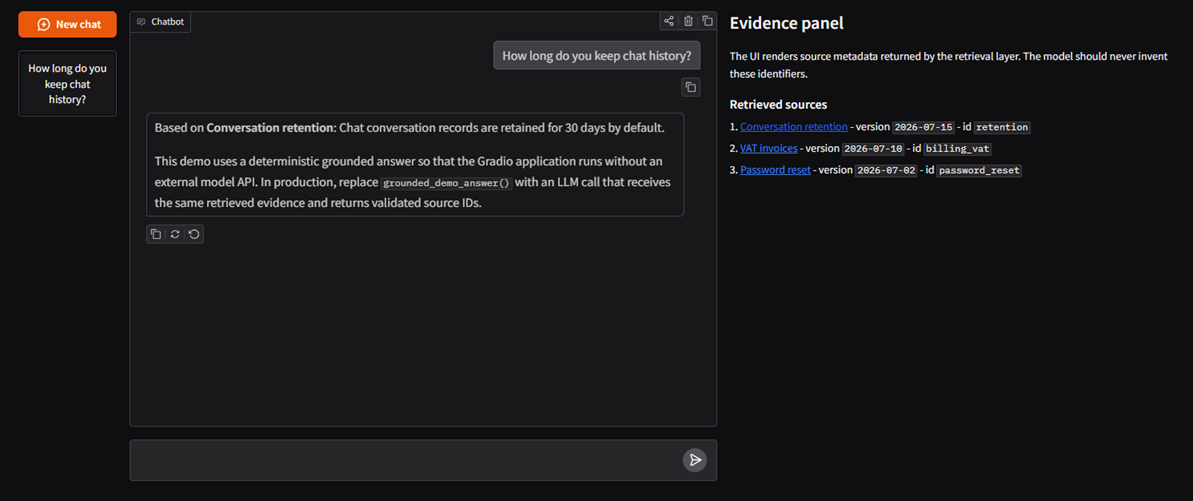
The important architecture boundary remains unchanged. Gradio renders the interaction. Retrieval decides which evidence is eligible and relevant. The generator produces the answer. Durable state, authorization, and audit records still belong to backend services rather than to the browser component.
A self-contained Gradio RAG demonstration
The following application is intentionally self-contained. It uses the same retrieval ideas developed earlier in the article: word TF-IDF, character TF-IDF, and Reciprocal Rank Fusion. It does not require an external model API, so the full UI can be executed without credentials.
The response generator is deterministic and extractive. That is a deliberate constraint, not a claim that an extractive function is equivalent to an LLM. The purpose of this example is to verify the complete UI contract: user message, retrieval, evidence gating, source rendering, streaming, chat history, and API exposure. In a production RAG system, grounded_demo_answer() is the function to replace with the chosen LLM adapter.
from __future__ import annotations

import argparse
import time
from dataclasses import dataclass

import gradio as gr
import numpy as np
from sklearn.feature_extraction.text import TfidfVectorizer
from sklearn.metrics.pairwise import cosine_similarity


@dataclass(frozen=True)
class Document:
    doc_id: str
    title: str
    text: str
    url: str
    version: str


DOCUMENTS = [
    Document(
        "retention",
        "Conversation retention",
        "Chat conversation records are retained for 30 days by default.",
        "/docs/privacy/conversation-retention",
        "2026-07-15",
    ),
    Document(
        "password_reset",
        "Password reset",
        "Reset a forgotten password from the sign-in page. "
        "A password reset link is sent to the verified email address.",
        "/docs/account/password-reset",
        "2026-07-02",
    ),
    Document(
        "billing_vat",
        "VAT invoices",
        "Business customers can download VAT invoices and billing receipts "
        "after payment.",
        "/docs/billing/vat-invoices",
        "2026-07-10",
    ),
    Document(
        "cancel_plan",
        "Cancel subscription",
        "Cancel a paid subscription from plan settings. "
        "Access remains active until the billing period ends.",
        "/docs/billing/cancel-subscription",
        "2026-07-08",
    ),
    Document(
        "rate_limits",
        "API rate limits",
        "Clients that exceed per-minute API request limits receive HTTP 429 "
        "and should retry with exponential backoff.",
        "/docs/api/rate-limits",
        "2026-07-12",
    ),
    Document(
        "sso_saml",
        "SAML single sign-on",
        "Enterprise workspaces can configure SAML SSO with an external "
        "identity provider.",
        "/docs/security/saml-sso",
        "2026-07-05",
    ),
    Document(
        "websocket",
        "WebSocket troubleshooting",
        "WebSocket clients should handle reconnects, idle timeouts, "
        "heartbeats, and transient network failures.",
        "/docs/realtime/websocket-troubleshooting",
        "2026-07-18",
    ),
    Document(
        "refund",
        "Refund policy",
        "Eligible payments can be refunded depending on purchase date "
        "and product terms.",
        "/docs/billing/refunds",
        "2026-07-11",
    ),
]


DOC_TEXTS = [
    f"{document.title}. {document.text}"
    for document in DOCUMENTS
]

WORD_VECTORIZER = TfidfVectorizer(
    ngram_range=(1, 2),
    stop_words="english",
)
CHAR_VECTORIZER = TfidfVectorizer(
    analyzer="char_wb",
    ngram_range=(3, 5),
)

WORD_MATRIX = WORD_VECTORIZER.fit_transform(DOC_TEXTS)
CHAR_MATRIX = CHAR_VECTORIZER.fit_transform(DOC_TEXTS)


def rank(scores: np.ndarray) ->, np.ndarray:
    return np.argsort(-scores)


def reciprocal_rank_fusion(
    rankings: list[np.ndarray],
    k: int = 60,
) ->, np.ndarray:
    fused = np.zeros(len(DOCUMENTS), dtype=float)

    for ranking in rankings:
        for position, index in enumerate(ranking, start=1):
            fused[index] += 1.0 / (k + position)

    return rank(fused)


def retrieve(
    query: str,
    top_k: int = 3,
) ->, tuple[list[Document], bool]:
    word_query = WORD_VECTORIZER.transform([query])
    char_query = CHAR_VECTORIZER.transform([query])

    word_scores = cosine_similarity(
        word_query,
        WORD_MATRIX,
    )[0]
    char_scores = cosine_similarity(
        char_query,
        CHAR_MATRIX,
    )[0]

    has_lexical_evidence = bool(
        np.max(word_scores) >, 0
        or np.max(char_scores) >, 0
    )

    fused_order = reciprocal_rank_fusion([
        rank(word_scores),
        rank(char_scores),
    ])

    documents = [
        DOCUMENTS[index]
        for index in fused_order[:top_k]
    ]

    return documents, has_lexical_evidence


def build_sources_markdown(
    documents: list[Document],
) ->, str:
    lines = ["### Retrieved sources"]

    for position, document in enumerate(
        documents,
        start=1,
    ):
        lines.append(
            f"{position}. [{document.title}]({document.url}) "
            f"- version `{document.version}` "
            f"- id `{document.doc_id}`"
        )

    return "\n".join(lines)


def grounded_demo_answer(
    message: str,
    documents: list[Document],
    has_evidence: bool,
) ->, str:
    if not message.strip():
        return "Enter a question."

    if not has_evidence:
        return (
            "I could not find lexical evidence for this question "
            "in the demo knowledge base. I will not answer from "
            "model memory."
        )

    primary = documents[0]

    return (
        f"Based on **{primary.title}**: {primary.text}\n\n"
        "This demo uses a deterministic grounded answer so that the "
        "Gradio application runs without an external model API. "
        "In production, replace `grounded_demo_answer()` with an LLM "
        "call that receives the same retrieved evidence and returns "
        "validated source IDs."
    )


def chat(
    message: str,
    history: list[dict],
):
    del history

    documents, has_evidence = retrieve(
        message,
        top_k=3,
    )
    sources = build_sources_markdown(documents)
    answer = grounded_demo_answer(
        message,
        documents,
        has_evidence,
    )

    step = 48
    for end in range(step, len(answer), step):
        yield answer[:end], sources
        time.sleep(0.01)

    yield answer, sources


def build_demo() ->, gr.Blocks:
    sources = gr.Markdown(
        value="### Retrieved sources\nAsk a question to inspect retrieval.",
        render=False,
    )

    with gr.Blocks(
        title="Documentation RAG Assistant",
    ) as demo:
        with gr.Row():
            with gr.Column(scale=3):
                chatbot = gr.Chatbot(
                    height=520,
                    placeholder=(
                        "<,strong>,Documentation RAG Assistant<,/strong>,<,br>,"
                        "Ask about retention, billing, API limits, "
                        "SSO, or WebSocket troubleshooting."
                    ),
                )

                gr.ChatInterface(
                    fn=chat,
                    chatbot=chatbot,
                    additional_outputs=[sources],
                    examples=[
                        "How long do you keep chat history?",
                        "What does HTTP 429 mean?",
                        "How do I cancel my paid plan?",
                        "websoket disconect reconect",
                    ],
                    save_history=True,
                    api_name="chat",
                )

            with gr.Column(scale=2):
                gr.Markdown(
                    "## Evidence panel\n"
                    "The UI renders source metadata returned by the "
                    "retrieval layer. The model should never invent "
                    "these identifiers."
                )
                sources.render()

    return demo


def self_test() ->, None:
    documents, has_evidence = retrieve(
        "How long do you keep chat history?",
        top_k=3,
    )

    assert has_evidence is True
    assert documents[0].doc_id == "retention"

    no_evidence_docs, no_evidence = retrieve(
        "zzqxxqv",
        top_k=3,
    )

    assert no_evidence is False
    assert len(no_evidence_docs) == 3

    demo = build_demo()
    assert isinstance(demo, gr.Blocks)

    print(f"gradio_version={gr.__version__}")
    print("retrieval_top1=retention")
    print("no_evidence_refusal=True")
    print("gradio_blocks_built=True")


if __name__ == "__main__":
    parser = argparse.ArgumentParser()
    parser.add_argument(
        "--self-test",
        action="store_true",
    )
    args = parser.parse_args()

    if args.self_test:
        self_test()
    else:
        build_demo().queue().launch()
Run the application locally
I executed the self-test for this exact file in the working environment. The environment used Gradio 6.5.1. Pinning the tested version is useful when reproducing a tutorial because UI libraries can change their public API.
python -m venv .venv
source .venv/bin/activate

pip install gradio==6.5.1 scikit-learn numpy

python gradio_rag_chatbot.py --self-test
python gradio_rag_chatbot.py
The self-test produced:
gradio_version=6.5.1
retrieval_top1=retention
no_evidence_refusal=True
gradio_blocks_built=True
The test verifies three properties. The retention query retrieves the intended document at rank one. A nonsense query produces no lexical evidence and therefore follows the refusal path. The Gradio Blocks application can be constructed successfully.
Why the source panel is a separate output
The assistant text and the evidence display should not be the same object. If the model is allowed to manufacture its own source list as prose, the application cannot reliably distinguish retrieved evidence from generated text.
In the example, retrieve() returns Document objects with trusted IDs, versions, and URLs. build_sources_markdown() renders those records outside the generated answer. The same pattern can be extended to signed document URLs, section anchors, source authority labels, or access-controlled links.
The Gradio documentation explicitly supports additional outputs from a ChatInterface. That makes the evidence panel an application output controlled by server-side code rather than a formatting convention inside the LLM response.
Streaming in Gradio
A Gradio chat function can be a Python generator. Each yield updates the current assistant response, which is why the example can stream partial text without custom JavaScript.
The demonstration streams an already-grounded deterministic answer in fixed-size chunks. A production LLM integration should instead yield model deltas or progressively validated text from the provider adapter. The retrieval result and source identifiers should normally be finalized before answer generation begins.
Streaming should not weaken output controls. If the application requires whole-answer validation, it may need to buffer the answer before showing it. If incremental rendering is permitted, validation needs to operate on streamed units or on claims before they become visible.
Gradio history is not your durable conversation store
Setting save_history=True makes Gradio preserve conversations in the browser's local storage and display previous chats in the interface. That is a useful product feature, but it is not equivalent to the durable run state discussed earlier in this guide.
Server-side run records are still required when the application needs auditability, cross-device continuation, operational recovery, tool state, centralized retention policy, or organization-level access control. Browser history can be deleted by the user and is scoped to that browser environment.
For a production system, treat the Gradio history argument as presentation context. Construct the authoritative model context from validated backend state.
Mount the Gradio UI inside an existing FastAPI application
Gradio also provides mount_gradio_app() for attaching a Blocks application to an existing FastAPI application. This is useful when authentication, health endpoints, REST APIs, background jobs, or other application routes already live in FastAPI.
from fastapi import FastAPI
import gradio as gr

from gradio_rag_chatbot import build_demo


app = FastAPI()

app = gr.mount_gradio_app(
    app,
    build_demo(),
    path="/chat",
)


@app.get("/health")
def health() ->, dict[str, str]:
    return {"status": "ok"}
I also constructed this mounted application successfully in the execution environment:
fastapi_routes=6
gradio_mount_built=True
With fastapi and uvicorn installed, the mounted version can be served with:
pip install fastapi uvicorn

uvicorn gradio_fastapi_mount:app   --host 0.0.0.0   --port 8000
The chatbot is then mounted under /chat, while the rest of the FastAPI application can keep its own routes and middleware.
Do not move production authorization into Gradio callbacks
A Gradio callback can inspect inputs and request metadata, but the interface should not become the authoritative security layer. Authentication and tenant scope should be resolved in trusted backend code, and retrieval filters should be derived from that authenticated state.
The same rule applies when the application is mounted into FastAPI. Gradio provides integration points, but authorization semantics remain an application responsibility. Retrieved document IDs, tool permissions, and tenant filters should come from server-side policy, not from hidden form values or model output.
Replacing the deterministic answerer with an LLM
The production adapter should preserve the current function boundaries. retrieve() should continue returning authorized evidence. A model adapter should receive the user question, selected passages, conversation state, and a generation policy. Its result should include answer text plus the source IDs it actually used.
The response checker can then verify that cited IDs were present in the supplied context before the answer reaches the browser. This keeps the Gradio layer independent from the model provider.
For an advanced implementation, avoid calling the provider SDK directly from UI event code. Put generation behind a service or adapter that owns timeouts, retries, model versioning, token budgets, structured output, tracing, and fallback behavior. Gradio should call that boundary rather than becoming the boundary.
Cache by semantic responsibility
Caching can reduce cost and latency, but it can also serve stale or unauthorized content.
Document embeddings can be cached by document version and embedding configuration. Retrieval candidates can be cached by normalized query, index version, and authorization scope. Reranker outputs can be cached by query, candidate IDs, and reranker version.
Final answer caching is riskier because the same question can require different responses for different users or times. The cache key must include every dimension that changes the answer's authority.
| Cached artifact | Important key material | Main invalidation trigger |
|---|---|---|
| Document embedding | Document version, embedding model, preprocessing | Document or representation change |
| Retrieval result | Query, filters, index build, user scope | Index or authorization change |
| Reranker output | Query, candidate IDs, reranker version | Candidate or model change |
| Final answer | Question, evidence versions, user scope, prompt and model versions | Any source, policy, model, or user-state change |
Budget latency by stage
Total response time does not reveal which component should be optimized.
Measure authentication, routing, retrieval, reranking, tool calls, context construction, time to first token, total generation, output checks, persistence, and delivery separately.
A slower model may not be the dominant problem if reranking takes 800 milliseconds and the vector service sits across a high-latency network boundary.
Use percentiles rather than only averages. Interactive systems are sensitive to tail latency because a small number of very slow responses dominate user frustration.
Control cost with bounded work
Every stage should have a budget.
Limit retrieval candidates, reranker candidates, context size, model output length, tool retries, and total tool calls. Bound conversation-history expansion and document-neighbor expansion.
An advanced chatbot should not have an unbounded loop that keeps retrieving or calling tools until the model decides it is done. The orchestrator should enforce explicit ceilings.
Choose the model on a quality-latency-cost frontier
The most capable model is not automatically the correct production model.
Run candidate models against the same retrieval context and evaluation set. Compare answer quality, refusal quality, structured-output reliability, time to first token, total latency, and cost.
Some traffic can justify routing to different models by task complexity, but routing itself becomes another component that requires evaluation and observability.
Observe the request as one distributed trace
OpenTelemetry defines traces as a way to represent a request path across processes and services, while metrics and logs provide complementary runtime signals.
A chatbot trace should connect the frontend request, routing decision, retrieval calls, reranker, model generation, tool calls, validation, and persistence through a shared trace or run identifier.
The trace should record stable IDs and versions rather than only raw text. Document IDs, prompt version, model version, index build, tool name, status, token counts, and latency are often more useful and safer to retain than complete sensitive payloads.
Separate observability from evaluation
Observability tells you what happened in a request. Evaluation tells you whether that behavior was good.
A trace can show that the retriever returned document A in rank one. The evaluation dataset determines whether document A was relevant for the query.
Production feedback should link the two. When a user or reviewer identifies a failure, the trace should be convertible into a regression case with reviewed expected behavior.
Monitor the knowledge pipeline, not only the chat endpoint
The API can be healthy while the knowledge base is stale.
Monitor source synchronization delay, ingestion failures, parser errors, number of indexed chunks, deleted-document propagation, embedding failures, index build age, language distribution, and authorization metadata coverage.
A retrieval system should not silently serve a previous index indefinitely after ingestion has failed. Freshness should have an explicit service objective where the business problem requires it.
Prompt injection is an application-security problem
The current OWASP GenAI security guidance identifies prompt injection as a major risk for LLM applications, including indirect prompt injection through external sources.
A RAG chatbot must assume that retrieved content can contain malicious or conflicting instructions.
Controls should exist outside the prompt: access filtering, tool allowlists, typed schemas, least privilege, output handling, domain restrictions, approval steps, and data-loss prevention where appropriate.
The model prompt can reinforce the policy, but it should not be the only barrier between untrusted text and a consequential action.
Treat rendered model output as untrusted web content
A website chatbot introduces ordinary web security concerns in addition to LLM risks.
If the model can produce HTML, Markdown links, code, or embedded content, the frontend should render through a controlled sanitizer and allowlist. Do not execute scripts or trust generated URLs merely because the model produced them.
External links can also create data-leak paths if sensitive information is appended to URLs. The rendering and navigation layer should enforce product security policy.
Tenant isolation must be proven with negative tests
Multi-tenant RAG systems need explicit tests showing that tenant A cannot retrieve tenant B's content.
Test both obvious and adversarial queries. Similarity search should not be able to cross the boundary because an unauthorized document is semantically perfect.
The authorization filter belongs before ranking or inside the search system, not after top-k results have been selected globally.
Apply least privilege to tools
Read-only tools and state-changing tools should not share the same permission model.
An assistant may have broad read access to documentation but only narrow transactional permissions. Sensitive actions should require authenticated context, resource ownership checks, policy validation, and sometimes explicit user or human approval.
A generated tool call is a proposal. It is not authorization.
Use failure injection before launch
Production reliability should be tested by deliberately breaking components.
| Injected failure | Expected behavior | Bad behavior |
|---|---|---|
| Vector index unavailable | Fallback, refusal, or degraded search according to policy | Generate from model memory without informing the user |
| Reranker timeout | Use validated candidate-ranking fallback | Hang until frontend timeout |
| Tool returns partial data | Mark result incomplete and avoid definitive decision | Treat partial data as complete |
| Knowledge build is stale | Alert and apply freshness policy | Continue indefinitely with no signal |
| Browser disconnects | Run state remains recoverable | Lose workflow state with the socket |
| Prompt-injected document is retrieved | Tool permissions remain unchanged | Retrieved text expands model authority |
Build release gates from component metrics
A release gate should block regressions even when the overall chatbot still looks fluent.
Define minimum retrieval performance, maximum citation-error rate, maximum unsupported-claim rate, minimum refusal quality, security-test pass criteria, latency ceilings, and cost limits.
Not every metric needs one universal threshold. Segment-specific gates may be required for high-risk product areas or languages.
Use shadow and canary evaluation for major changes
Embedding migrations, reranker replacements, large prompt changes, and model upgrades should not immediately replace the entire production path.
Shadow evaluation can run the candidate path on production-like queries without serving its output. Canary rollout can expose a small traffic percentage after offline gates pass.
Compare the same query across old and new paths using stable run identifiers. Preserve source IDs and stage timing so that differences are explainable.
Index promotion should be atomic
A knowledge build is a deployable artifact.
Build the new index separately, run retrieval regression tests, verify document counts and authorization metadata, then promote a complete build identifier.
Do not update production vectors incrementally in a way that creates a long mixed state unless the system is designed and evaluated for that migration pattern.
Rollback should mean selecting the previous compatible index build and matching query encoder, not reconstructing the old state manually.
Keep a regression corpus from real incidents
The most valuable evaluation cases often come from production failures.
When a user reports a wrong answer, classify the root cause: routing, retrieval, stale source, access filter, context packing, generation, citation, tool result, conversation state, or interface behavior.
Add a minimized reviewed case to the regression suite. Over time, the evaluation set should represent the system's actual failure history rather than only the cases imagined before launch.
Product metrics should not replace technical metrics
Containment rate, support deflection, conversation completion, click-through, and user satisfaction are important product signals.
They do not identify why the system changed. A higher deflection rate can be good if answers improved or bad if users gave up and stopped contacting support.
Technical evaluation and product metrics should be analyzed together. The model should not be optimized to maximize engagement if the actual objective is correct problem resolution.
A complete evaluation matrix
| Layer | Core measurements | Representative failure |
|---|---|---|
| Routing | Route accuracy, clarification quality | Tool question incorrectly sent to document retrieval |
| Retrieval | HitRate, Recall, MRR, nDCG, source freshness | Correct policy missing from top candidates |
| Reranking | Relevant-source promotion, hard-negative ordering | Old but similar policy ranked above current policy |
| Generation | Correctness, completeness, support, refusal | Evidence is present but answer invents an exception |
| Citations | Correctness and coverage | Cited source does not support associated claim |
| Tools | Argument validity, authorization, completeness, side-effect correctness | Partial account data treated as complete |
| Security | Tenant isolation, prompt-injection resistance, output handling | Private source retrieved for unauthorized user |
| System | Latency, errors, availability, cost, reconnect success | Reranker timeout creates full request failure |
| Product | Resolution, escalation, feedback, repeat-contact rate | Technically correct answers do not solve the user's task |
Recommended production request path
A mature request path can be described in a deterministic sequence even when individual components are model-based.
Authenticate and resolve user scope first. Load durable conversation state. Normalize the latest user request and decide whether the task requires clarification, RAG, tools, or a conversational response. If retrieval is required, construct a query and authorization filter, obtain sparse and dense candidates, fuse and rerank them, then build a bounded evidence context.
Run tools only through server-side authorization. Construct the generation request from system policy, structured state, tool results, and retrieved evidence. Generate a draft with source IDs. Validate output structure and grounding according to risk. Persist the durable answer and stream or return the final representation.
The exact order can vary, but each stage should have an owner, version, timeout, trace span, and fallback.
A practical implementation roadmap
| Phase | Deliverable | Exit condition |
|---|---|---|
| 1. Scope and authority | Supported questions, source registry, refusal and escalation policy | Owners agree on what the chatbot may answer and do |
| 2. Knowledge pipeline | Parser, chunker, metadata, ACLs, versioned index | Indexed chunks are inspectable and source-complete |
| 3. Retrieval baseline | Sparse benchmark and reviewed query set | Retrieval metrics meet a useful baseline |
| 4. Advanced retrieval | Dense retrieval, fusion, reranker, context builder | Added complexity improves important benchmark segments |
| 5. Grounded generation | Prompt, citations, refusal, answer evaluation | Generation passes with fixed evidence |
| 6. Tools and state | Authenticated reads, approvals, durable conversation state | Tool and multi-turn tests pass |
| 7. Production controls | Streaming, caching, observability, security, failure handling | Failure injection and latency budgets pass |
| 8. Release process | Offline gates, shadow, canary, rollback, incident feedback | Every major component can be promoted and rolled back independently |
What I would use as a conservative default
For a documentation-heavy website chatbot, I would begin with a durable HTTP API for sessions and results plus SSE for one-way token streaming. I would move to WebSocket only if the interface requires frequent bidirectional events.
The knowledge path would use structural chunks, strict metadata and tenant filters, a sparse baseline, a dense retriever, fusion, a bounded reranker, and a context builder that keeps stable source IDs. I would not expose a write tool in the first release.
Evaluation would begin with a reviewed retrieval set and fixed-evidence answer set. Production traces would preserve stage versions and document IDs, while raw user content would follow a deliberate retention policy.
When not to build RAG
A twenty-question static FAQ may not justify a retrieval platform. Curated answers can be more predictable, cheaper, and easier to govern.
A chatbot whose primary task is displaying current account state may mostly need tool APIs and a small policy knowledge base rather than thousands of embeddings.
A search interface can also be better than generated synthesis when users need to inspect exact documents and the risk of paraphrasing is high.
The right architecture is the simplest system that meets the evidence, interaction, and risk requirements.
Common advanced design mistakes
Using similarity as permission
Retrieval relevance and authorization solve different problems. Apply access policy before evidence reaches the model.
Changing retrieval and generation simultaneously
This destroys diagnostic clarity. Promote one major component at a time or use controlled factorial experiments when simultaneous changes are necessary.
Keeping only final answers in logs
A wrong answer cannot be diagnosed without retrieval IDs, tool status, model and prompt versions, and stage timing.
Using a single global similarity threshold
Similarity scales change across models, queries, and corpora. Calibrate decisions against reviewed examples and consider segment-specific behavior.
Allowing the context window to become a database
More context is not automatically safer. Retrieval and ranking should select evidence instead of relying on the model to search an enormous prompt.
Treating an LLM evaluator as ground truth
Automated judges are measurement models. Version them and validate them against human review.
Key takeaways
- A production website chatbot is a distributed application with ML components. The LLM should not own authorization, durable state, source truth, or recovery behavior.
- A strong RAG system is built as a measured pipeline: ingest and version knowledge, filter access, retrieve broadly, rerank, pack bounded evidence, generate with source IDs, validate, and evaluate retrieval separately from generation.
- Advanced reliability comes from operational controls around the model: least privilege, prompt-injection defenses, traces, failure injection, component release gates, index rollback, canary deployment, and a regression suite built from real incidents.
Sources
- Lewis, P., Perez, E., Piktus, A., et al. (2020). Retrieval-Augmented Generation for Knowledge-Intensive NLP Tasks. Karpukhin, V., Oguz, B., Min, S., et al. (2020). Dense Passage Retrieval for Open-Domain Question Answering. Liu, N. F., Lin, K., Hewitt, J., et al. (2024). Lost in the Middle: How Language Models Use Long Contexts. Ru, D., Qiu, L., Hu, X., et al. (2024). RAGChecker: A Fine-grained Framework for Diagnosing Retrieval-Augmented Generation.
- NIST. (2024). Artificial Intelligence Risk Management Framework: Generative Artificial Intelligence Profile. OWASP GenAI Security Project. GenAI Security Project, Prompt Injection, and LLM Prompt Injection Prevention Cheat Sheet.
- pgvector. Official pgvector repository and hybrid-search guidance. OpenTelemetry. Signals: traces, metrics, and logs. FastAPI. WebSockets. Gradio. ChatInterface, Blocks, and mount_gradio_app.